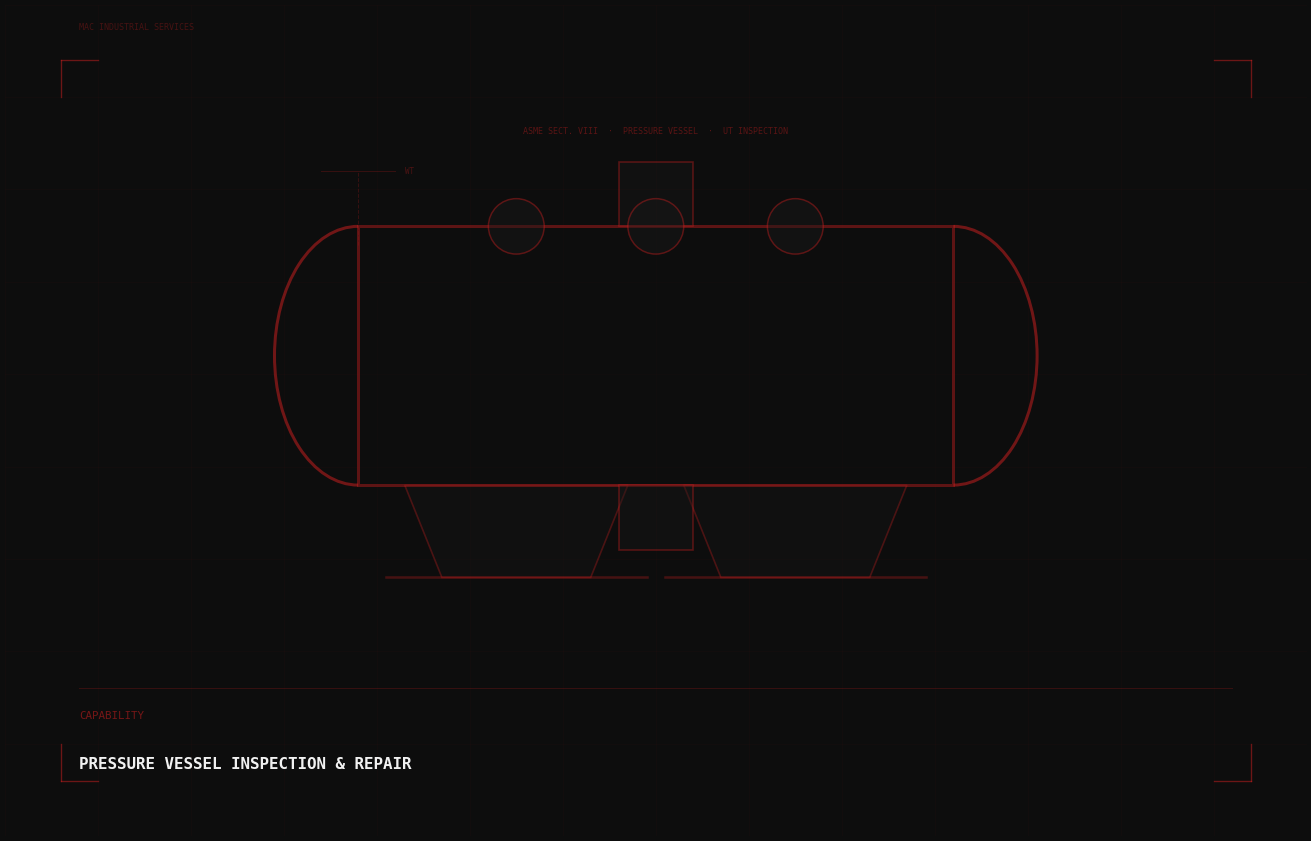
Pressure Vessel Inspection & Repair
Inspection, fitness-for-service assessment, repair welding, and code-compliant restoration of pressure vessels operating under ASME Section VIII, API 510, and related pressure equipment regulations.
Pressure vessels — columns, drums, reactors, condensers, and accumulators — are among the most heavily regulated pieces of equipment in industrial plants. Their failure under pressure can be catastrophic, and the codes governing their inspection, repair, and alteration are correspondingly stringent. MAC Industrial Services provides pressure vessel inspection support, repair welding, and code-compliant restoration services for operating plants where vessel integrity is a critical reliability and safety concern.
The most common pressure vessel repair needs involve nozzle repairs (cracking, corrosion at weld heat-affected zones), shell plate corrosion requiring weld overlay or patch plate installation, manway and handhole nozzle replacement, and internal attachment repairs. MAC repair welders are qualified to the materials and positions required for these repairs, and all work is executed under the requirements of ASME PCC-2 and, where applicable, under National Board R-Stamp repair authority.
For aging vessels exhibiting general or localized corrosion, weld overlay — also called cladding or hard-facing — is a code-accepted technique for restoring wall thickness without complete replacement. MAC can perform corrosion-resistant weld overlay using stainless steel or nickel-alloy filler materials in vessels where the process fluid is corrosive to the base metal. We also provide fitness-for-service support in coordination with inspection engineers to evaluate whether a vessel with identified defects can remain in service until the next planned inspection opportunity.
What We Deliver
Technical Q&A
What is the R-Stamp and why does it matter for pressure vessel repair?
The R-Stamp is issued by the National Board of Boiler and Pressure Vessel Inspectors and authorizes repair organizations to perform repairs and alterations on code-stamped pressure equipment. R-Stamp repair work is documented on National Board Form R-1 and involves Authorized Inspection Agency (AIA) oversight. Repairs performed without R-Stamp authorization may invalidate the vessel's code stamp and create liability for the vessel owner.
What is fitness-for-service (FFS) assessment and when is it needed?
FFS assessment, performed under API 579-1/ASME FFS-1, evaluates whether a vessel with known damage or defects can continue safe operation until the next planned inspection or repair opportunity. It is used when inspection finds conditions (pitting, cracking, corrosion, dents) that exceed the acceptance criteria for continued service under standard inspection codes. MAC provides repair services and coordinates with inspection engineers to support the FFS process.
Related Service Lines
Welding & Fabrication
High-quality welding and fabrication services meeting the most stringent industrial codes and standards, including specialty alloy work.
Outage Services
Expert management of planned and forced outages, delivering rapid mobilization and efficient execution to minimize your downtime.
Industrial Maintenance
Comprehensive maintenance services designed to maximize uptime, reduce operational costs, and extend the life of your industrial assets.
Industry Applications
- Power plant flash tanks, deaerators, and feedwater heaters
- Refinery and petrochemical reactor vessels
- Chemical plant storage and process vessels
- Industrial compressed air and gas receivers
- Steam drum and steam separator maintenance
- FGD absorber vessel structural repair
Codes & Standards
- ASME Section VIII Div. 1 – Rules for Construction of Pressure Vessels
- ASME Section IX – Welding and Brazing Qualifications
- API 510 – Pressure Vessel Inspection Code
- ASME PCC-2 – Repair of Pressure Equipment and Piping
- NBIC NB-23 – National Board Inspection Code (R-Stamp repairs)
Need this capability?
Talk to our team about your specific project requirements.
Contact MAC IndustrialMore Industrial
Explore our full capability set
Twelve specialty areas across power, industrial, and process sectors.